 By Rohit Mehra
 Two immigrants leave the same country, settle in different cities, and grow into completely different people — that’s essentially the story of pizza’s journey from Naples to New York. Neapolitan pizza stayed close to its roots: small, blistered, eaten with a fork in Italy’s south. New York pizza became something else entirely once Italian immigrants adapted it to American flour, American ovens, and a city that wanted to eat slices standing up on the sidewalk. Both are unmistakably pizza. Neither would be mistaken for the other. Here’s what actually separates them.
The Dough Tells the Whole Story First
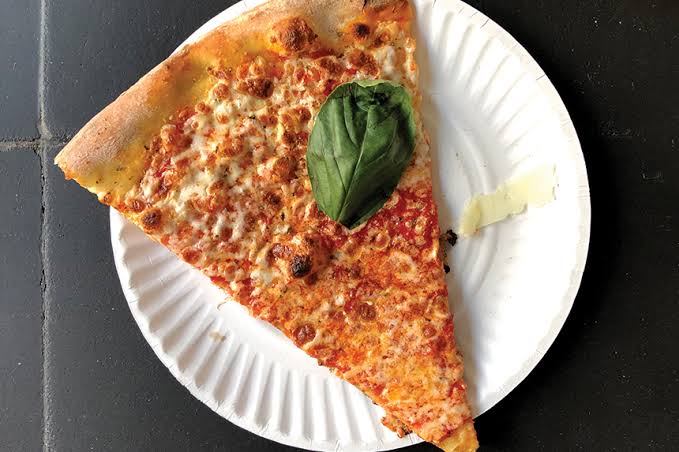
Before toppings or sauce even enter the picture, the dough itself sets these two pizzas on entirely different paths.
- Neapolitan dough uses just four ingredients — flour, water, salt, and yeast — with Italian “00” flour specifically required under traditional Associazione Verace Pizza Napoletana guidelines
- New York dough typically includes oil and sometimes a touch of sugar, ingredients Neapolitan purists would consider unnecessary additions
- Neapolitan dough ferments for a relatively short period, often 8-24 hours, producing a lighter, more delicate structure
- New York dough often undergoes a longer, colder fermentation, sometimes 24-72 hours, developing a chewier, more structured crumb built specifically to hold up under toppings and folding
Crust Texture and Thickness Diverge Completely
This is where the two styles become instantly recognisable apart, even from across a room.
- Neapolitan crust is thin at the base but puffs up dramatically at the edges into a pillowy, charred “cornicione,” soft enough that the centre is often eaten with a knife and fork
- New York crust is thinner and more uniform edge to edge, engineered specifically to be foldable — the famous “New York fold” that lets you eat a slice one-handed while walking
- The Neapolitan crust’s high hydration dough and rapid, blazing-hot bake create large, irregular air pockets throughout
- New York crust, baked at lower temperatures for longer, develops a firmer, crackier bottom that can support a slice without the tip drooping too dramatically
The Ovens Are Doing Fundamentally Different Jobs
Temperature and cooking time aren’t small technical details here — they’re the single biggest reason these two pizzas can’t be interchanged.
- Traditional Neapolitan pizza bakes in a wood-fired oven at temperatures reaching 800-900°F, cooking a whole pizza in just 60-90 seconds
- That extreme, brief heat is precisely what creates the signature leopard-spotted char on the crust while keeping the centre soft and almost custardy
- New York pizza bakes at a considerably lower 500-550°F for roughly 10-15 minutes in a deck oven, a slower process that dries and firms the crust throughout
- This temperature gap alone explains why you can’t simply “make New York pizza in a Neapolitan oven” or vice versa — the entire dough and topping ratio is built around its specific bake
Toppings Follow Very Different Philosophies
What goes on top, and how much of it, reflects two very different ideas about what pizza is supposed to be.
- Classic Neapolitan pizza, particularly the iconic Margherita, uses minimal toppings — San Marzano tomatoes, fresh mozzarella di bufala, basil, and olive oil, nothing more
- The restraint is deliberate — with such a short bake time, there’s no opportunity for excess moisture to cook off, so overloading the pizza results in a soggy, undercooked centre
- New York pizza embraces a heavier hand with low-moisture, part-skim mozzarella that melts into an even, stretchy layer rather than pooling like fresh mozzarella does
- Toppings on New York pizza — pepperoni, sausage, vegetables — are more generously applied, since the longer, lower-heat bake gives excess moisture time to cook away without ruining the crust
Size and Serving Style Reflect Two Different Eating Cultures
Even how these pizzas are meant to be eaten reveals how differently each city adopted the same original dish.
- A traditional Neapolitan pizza is personal-sized, roughly 10-12 inches, meant for one person, uncut, and eaten with utensils rather than by hand
- New York pizza is typically sold as a large 18-inch pie cut into large triangular slices, designed explicitly for sharing or grabbing a single slice on the go
- The Neapolitan tradition treats pizza as a sit-down meal course, closer to how you’d approach any other Italian dish
- New York pizza became street food in the truest sense — folded, eaten walking, sold by the slice at counters rather than exclusively as whole pies at a table
Where the Names Actually Come From
The regional identity baked into each style isn’t just marketing — it traces back to genuinely different historical origins.
- Neapolitan pizza originated in Naples, Italy, and its production is protected under EU law through the Specialità Tradizionale Garantita designation, with strict rules governing ingredients and method
- New York pizza emerged from Italian immigrants, largely from Naples and southern Italy, adapting their techniques to American ingredients, coal and gas ovens, and city life in the early 1900s
- Lombardi’s, often credited as America’s first pizzeria, opened in New York’s Little Italy in 1905, marking the point where this Americanised style began developing its own identity
- Over a century of separate evolution has widened the gap between the two considerably further than a simple “original versus adaptation” framing suggests
Frequently Asked Questions
Q. Can I make authentic Neapolitan pizza in a regular home oven?
Not exactly, since most home ovens can’t reach the 800°F+ needed. A pizza steel and the highest oven setting gets you closer, but not identical.
Q. Why does New York pizza taste different even using the same toppings?
The dough recipe, hydration level, and slower bake fundamentally change the crust’s texture and flavour, independent of whatever toppings you add.
Q. Is one style considered more “authentic” than the other?
Neapolitan is the historical original and legally protected in Italy. New York pizza is a distinct, century-old evolution, not a lesser copy.
Q. Why is New York tap water often credited for the crust’s taste?
Many bakers believe New York’s specific water mineral content affects gluten development, though the science on this remains genuinely debated.